Monday, May 11, 2009

The Secret of Self-control, willpower and discipline?

The New Yorker Magazine had a great article on what research has uncovered about delayed gratification and what an essential life skill it is. 

It seems learning simple and easy self-control skills can have a huge effect on how one's life develops, but few people learn those skills. So I've highlighted some some excerpts, but I suggest reading the whole article.

"...after just a few sessions, students show significant improvements in the ability to deal with hot emotional states...even the most mundane routines...are really sly exercises in cognitive training: we’re teaching ourselves how to think so that we can outsmart our desires."
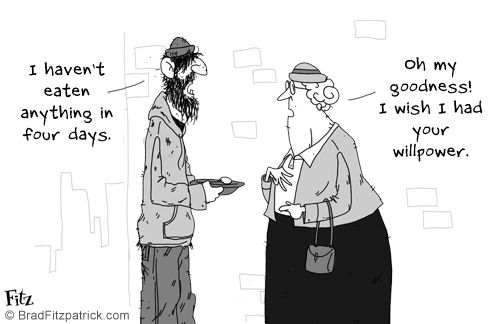
"...the ability to delay gratification [is] a far better predictor of academic performance than I.Q."

"Once you realize that will power is just a matter of learning how to control your attention and thoughts, you can really begin to increase it."

And there are tricks you can use that work terrifically well. For example:

"...Mischel has found a shortcut. When he and his colleagues taught children a simple set of mental tricks—such as pretending that the candy is only a picture, surrounded by an imaginary frame—he dramatically improved their self-control. The kids who hadn’t been able to wait sixty seconds could now wait fifteen minutes. 'All I’ve done is given them some tips from their mental user manual,' Mischel says. 'Once you realize that will power is just a matter of learning how to control your attention and thoughts, you can really begin to increase it.' "

"...he previously showed that children did much better on the marshmallow task (waiting before eating a marshmallow) after being taught a few simple 'mental transformations,' such as pretending the marshmallow was a cloud..."

"Interestingly, the scientists found that high delayers were significantly better at [being] less likely to think that a word they’d been asked to forget was something they should remember."


Read more!

Thursday, April 30, 2009

Principles of Ethical Influence, by Dr. Robert Cialdini

I'm always trying to promote the principles of ethical influence (by Dr. Robert Cialdini) to people, and I've recently discovered he makes them available in pocket guide form on his website, along with all his terrific books and other materials.

Click the image for more information:

The principles are:
  1. Reciprocation — You, then me, then you, then me…
  2. Scarcity — The rule of the rare.
  3. Authority — Showing knowing.
  4. Consistency — The starting point.
  5. Liking — Making friends to influence people.
  6. Consensus — People proof, people power.

The ethical use of influence means:
  • Being honest;
  • Maintaining integrity;
  • Being a detective, not a smuggler or bungler.
From Gerard Kroese's review of an article (reprint available for download) by Cialdini:
Cialdini believes that five decades of research by behavioral scientists shows that persuasion is governed by six fundamental principles that can be taught, learned, and applied. Each principle is named, linked to an application and discussed:

(1) The principle of Liking: People like those who like them, whereby two compelling factors reliably increase liking: similarity and praise.

(2) The principle of Reciprocity: People repay in kind, whereby the application is "give what you want to receive."

(3) The principle of Social Proof: People follow the lead of similar others. "Stated simply, influence is often best exerted horizontally rather than vertically."

(4) The principle of Consistency: People align with their commitments. The author's research "has demonstrated that most people, one they take a stand or go on record in favor of a position, prefer to stick to it."

(5) The principle of Authority: People defer to experts. "The task for managers who want to establish their claims to expertise is somewhat more difficult. ... A little sublety is called for."

(6) The principle of Scarcity: People want more of what they can have less of. "Study after study shows that items and opportunities are seen to be more valuable as they become less available. That's a tremendously useful piece of information for managers."

These 6 principles of persuasion are not new and have been known within the psychology field for around 10-20 years. However, in the form provided by Cialdini they are easy to grasp and understand.


Read more!

Monday, March 16, 2009

Ways to make money on the web

So you want to make money on the internet, huh? Below are some of the most common ways. 

Why do I bother sharing a list like this? Because a key reason most people fail is they fail to consider their options before starting.

My highlights are not strictly accurate, because there are good approaches to each of these things. I'm going to elaborate on this over time and link to information as I go:

The best combination of profit and simplicity for web newbies.
The things people tend to try most frequently.
The best profit for people who are willing to work steadily without quitting

A. Sell information:
  1. Create information and sell it;
  2. Sell someone else's information as if it were your own;
  3. Promote someone else selling information.
B. Create content, and then place around what you write:
  1. Ads that pay when someone acts on them (clicks an ad, for example);
  2. Ads that pay based on how many people see them;
  3. Information for sale that you receive a commission on;
  4. Products for sale that you receive a commission on;
  5. Links to other sites where you earn money.
C. Help people with existing businesses:
  1. Sell their services;
  2. Sell their products;
  3. Set up or enhance a web presence.

D. Sell products:
  1. Drop-ship (you sell something that someone else ships for you);
  2. Buy products and ship them yourself;
  3. Via multi-level marketing.
Start a product or service business of your own and use the web to promote

B2 is essentially a strategy to get a lot of traffic to a focused niche. It's a little misleading, because basically you can't even get these kinds of ads unless you get a lot of traffic to your content. So B2 represents a strategy to get a lot of traffic and the longer you work it, the better it works. Realize that once you have a lot of traffic, you can do other things with it as well.


Read more!

Friday, March 13, 2009

Apologies for not having more time for family, friends and clients lately!

I've gotten very busy these last few months. Apologies to those of you I haven't been spent as much time with as you would like! I feel a little silly putting down so much detail, but I'm getting a lot of disbelief that I don't have more time, so...

You would have to be away from home working 20 hours a day if you only worked weekdays from an office to get the same amount of work done as I do, assuming:

  • 40 minutes of round-trip drive time to and from work, eating breakfast in the car
  • Two meetings/week
  • Getting ready each morning (I'm at the computer within 30 seconds most mornings)
  • Standard breaks
  • 30 minutes for dinner
As it is, I pretty consistently get about 12.5 hours of work done every day, seven days a week regardless of holidays. Again, that doesn't mean I work a "12 1/2 hour day." More like a 14-hour day the way most folks mean it. I almost always keep working while talking on the phone, and each week I use a variety of methods to automate what I do more and more. I'm working from home, and my wife Sarah takes care of all errands and meals so I can keep working.

Frustratingly, most of the people I have outsourced to haven't worked out, from coders to virtual assistants. 

Nevertheless, some family and friends still figure I must take breaks or spend time on miscellaneous stuff; basically that I have more free time than I realize. Actually, no, I don't. Here are the non-work things I do each week, using time-tracking software to indicate about how much time these take me each week:
  • I don't own a TV, but once a week I do watch one show over the internet or go out to see a movie (1.5 hours).
  • A little more than every other week Sarah and I go out for something else, sometimes just me going on errands with her, or to visit family (2 hours).
  • I browse the internet for miscellaneous stuff or general news headlines about 20 minutes a day, much, much, much less than I used to (2.5 hours).
  • I do a small number of miscellaneous things a month—like this blog post (1.75 hours). 
  • I exercise about 20 minutes/day away from the computer (2.5 hours) and some at the computer. I eat one meal a day away from the computer with Sarah so we can talk more (4.5 hours). 
  • Sarah and I also talk a very little bit during the day about non-work things (2.5 hours).
  • I do tech support for family and clients a few times a week. (1.25 hours).
  • Appointments outside home  (2).
  • Contemplation breaks (3 hours).
  • I sleep about 8 hours, but spend an additional few minutes falling asleep and another 45 minutes reading or talking in bed most evenings (63 hours).
I have someone screen all my calls and emails and a lot of my internet messages so I don't get interrupted much, and each week I organize or automate a little more for Sarah or a virtual assistant to do for me.

Since I run a 24-hour news service 7 days a week, it's hard to outsource things to people who aren't responsive on a hourly basis, which few can be. But I'm just reaching the point where automation will allow me to hire more folks to do some of my work. This means I can put more attention onto some longer-term projects.


Read more!